
The Tournament Before Messi
The FIFA World Cup has been the sport’s grandest stage since Uruguay hosted and won the inaugural edition in 1930. Across nearly a century, the tournament has produced its own pantheon: Pelé, the only man to win it three times as a player; Diego Maradona, who carried Argentina to glory almost single-handedly in 1986; Franz Beckenbauer, Zinedine Zidane, Ronaldo Nazário. By the time a teenage Lionel Messi was breaking through at Barcelona in the mid-2000s, the World Cup already had its legends. What it didn’t have yet was him.
2006: The Debut
Messi arrived at his first World Cup in Germany as an 18-year-old prodigy, already a star at club level but largely untested on the international stage. He came on as a substitute in Argentina’s group-stage rout of Serbia and Montenegro, becoming one of the youngest players to ever appear for the Albiceleste at a World Cup. Argentina were eliminated in the quarterfinals by Germany on penalties, with coach José Pékerman drawing criticism for leaving Messi on the bench in that decisive match. It was a quiet start to what would become the defining storyline of international football for the next two decades.
2010: South Africa and Frustration
By 2010, Messi was widely regarded as the best player in the world, fresh off a Ballon d’Or and a treble with Barcelona. Expectations were enormous, and Diego Maradona — now Argentina’s head coach — built the team around him. But the World Cup in South Africa never clicked for Messi personally; he set up several goals but didn’t score one himself, and Argentina were dismantled 4-0 by Germany in the quarterfinals. The gap between Messi’s club brilliance and his international output became a recurring narrative in Argentine and global media.
2014: Brazil and the Final That Slipped Away
Brazil 2014 was, for a long time, considered Messi’s best chance. He scored four goals in the group stage, including a stunning solo winner against Iran, and dragged a workmanlike Argentina side through to the final. There, Argentina met Germany in Rio de Janeiro, and the match stayed scoreless until extra time, when Mario Götze volleyed in the winner. Messi was named the tournament’s best player, awarded the Golden Ball, but he later said the trophy felt hollow without the title to go with it. He briefly announced his retirement from international football the following year out of frustration, only to reverse the decision.
2018: An Early Exit in Russia
The 2018 World Cup was a difficult tournament for both Messi and Argentina. The team struggled to qualify smoothly, stumbled through the group stage, and were eliminated in the round of 16 by a rampant France side led by a teenage Kylian Mbappé. Messi, by then 31, faced louder questions than ever about whether he would ever win the one trophy that had eluded him.
2022: Qatar and Redemption
Everything changed in Qatar. Argentina opened with a shock loss to Saudi Arabia, but Messi and a deeply bonded squad built momentum match by match, with Messi producing some of the finest football of his career at exactly the moment it mattered most. He scored crucial goals throughout the knockout rounds, including a brilliant solo effort against Croatia in the semifinal, and then delivered arguably the greatest individual World Cup final performance in the tournament’s history against France: two goals in regulation, another in extra time, and the captaincy through a match that finished 3-3 before Argentina won on penalties. At 35, Messi finally lifted the World Cup, completing a career that had won every major club honor and was now, indisputably, complete. He was named the tournament’s best player for a record second time.
2026: A Sixth World Cup, and History Repeating
Messi is currently competing in his sixth World Cup, co-hosted by Canada, Mexico, and the United States — a record for an Argentine player and a rare feat for any footballer reaching the tournament at 38 years old. Argentina arrived as defending champions, chasing a feat no nation has managed since Brazil in 1962: winning back-to-back titles. Coach Lionel Scaloni kept the spine of the Qatar-winning squad largely intact, with Messi handed the captaincy once again despite a hamstring scare in the buildup to the tournament.
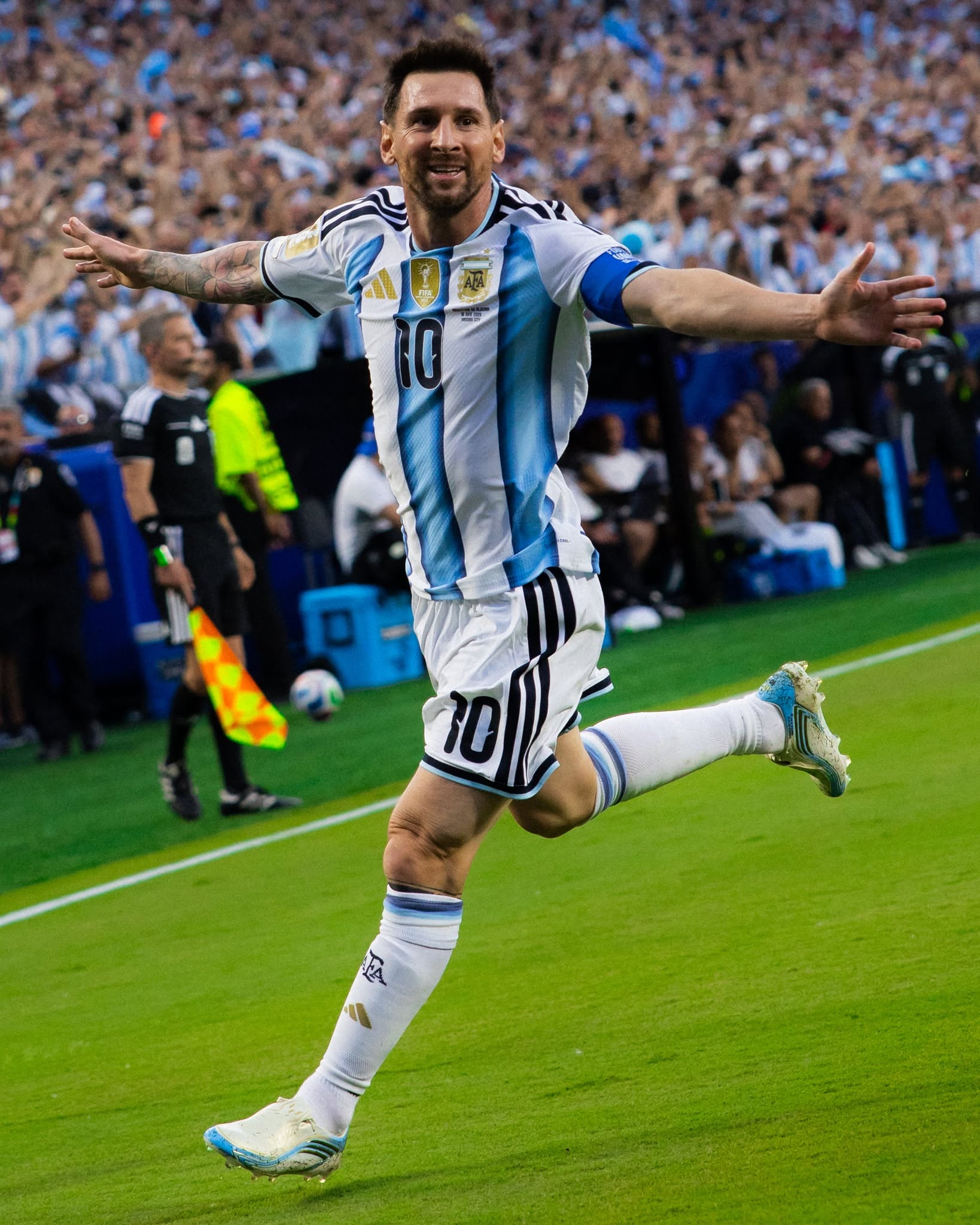
And on June 16, 2026, in Argentina’s tournament opener against Algeria in Kansas City, Messi produced a moment that instantly reshaped the World Cup record books. He scored a hat-trick in a 3-0 win, taking his career World Cup goal tally to 16 and drawing level with Germany’s Miroslav Klose for the all-time World Cup scoring record — a mark Klose had held since 2014. The timing carried its own poetry: the match fell almost exactly twenty years to the day after Messi’s World Cup debut as a substitute against Serbia and Montenegro in 2006. With Group J fixtures against Austria and Jordan still to come, Messi has a clear opportunity to claim the scoring record outright before the knockout rounds begin.
A Career Measured Against the Tournament Itself
Few players’ careers map so closely onto the World Cup’s own arc of stories — the wide-eyed teenager, the frustrated genius, the nearly-man, and finally the champion. Messi’s history with the tournament has become, in many ways, a history of the tournament’s modern era. Whatever happens for Argentina the rest of the way in 2026, he has already added another chapter: a teenager who debuted as a substitute in 2006 now stands level with the greatest goal-scorer the World Cup has ever seen.